


Views: 0 Author: Site Editor Publish Time: 2026-06-16 Origin: Site


Traditional blind corner cabinets present a notorious design flaw in almost every home. These deep, awkward spaces waste valuable square footage. Homeowners constantly battle inaccessible items and endure physical strain simply retrieving cookware buried far in the back. Upgrading your internal hardware stands out as a high-ROI decision. It instantly boosts daily kitchen functionality. Yet, guessing which mechanism to buy often leads to frustrating installation failures. Worse, it causes permanently damaged cabinetry. You need an objective, spec-driven approach to evaluate these corner storage solutions accurately. We will help you navigate the exact hardware specifications required for a seamless fit. You will learn how to match the right system to your specific cabinet dimensions, personal budget, and everyday usage requirements. Precision matters. By understanding exact measurements and structural mechanics, you ensure you never lose a pan to the back of the cupboard again.
The right kitchen pull out basket depends primarily on your cabinet’s specific door opening width, interior depth, and whether the frame is inset or overlay.
A magic corner basket maximizes total storage volume, while cloud-shaped (LeMans) pull-outs offer smoother, independent shelf access.
Weight capacity dictates usage: heavily loaded cast-iron pans require heavy-duty bottom-mounted tracks, not standard side-mounted wire baskets.
Retrofitting an existing corner cabinet presents clearance challenges (e.g., protruding appliance handles or hinges) that must be measured before purchase.
Most homes feature a standard corner cabinet bridging two perpendicular counter runs. Builders traditionally install basic static shelves inside. This creates an immediate ergonomic disaster.
Standard blind corner cabinets stretch 36 to 42 inches deep. The door opening only exposes half of this cavernous space. The remaining half becomes a functional dead-zone. You cannot see what sits in the back. You cannot reach it without kneeling on the floor and extending your entire torso into the dark cavity. Because humans naturally avoid physical discomfort, the back 50% of the shelf devolves into a graveyard for forgotten appliances and expired pantry goods. The static shelf turns your most spacious cabinet into the least efficient one.
Many homeowners assume a Lazy Susan solves the corner dilemma. These traditional round spinning trays do offer marginal improvement over static shelves. However, they carry significant flaws. A round tray placed inside a square cabinet leaves the deep corners completely unused. Furthermore, round trays lack protective barriers. When you spin the unit too quickly, boxes and bowls slide off the back edge. You must then empty the entire cabinet to retrieve the jammed item. Modern pull-out hardware eliminates this issue. These systems physically bring the inventory out of the cabinet and into the light.
Before purchasing replacement hardware, we must define what success looks like. A successful cabinet upgrade achieves three distinct goals. First, it guarantees 100% visibility of all stored items. Second, it requires zero physical straining or heavy lifting from awkward angles. Third, it guarantees clearance safety. The mechanism must operate smoothly without grazing adjacent cabinet doors or scratching expensive finishes.
Hardware manufacturers engineered three primary mechanisms to conquer the blind corner. Each system utilizes unique spatial geometry. Each offers specific benefits depending on what you plan to store.
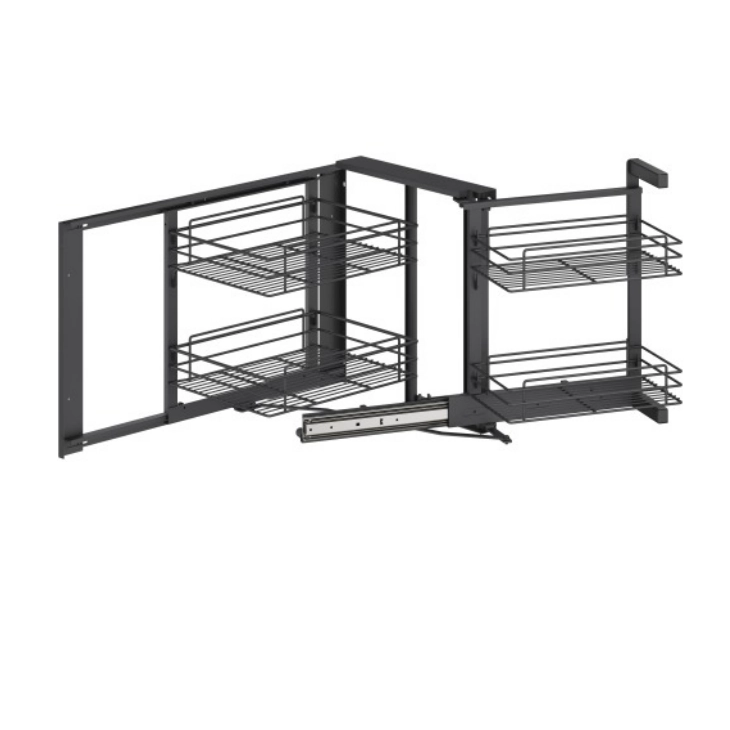
Mechanism: This system utilizes a sophisticated two-stage sliding track. You pull the front frame out of the cabinet. As the front frame pivots to the side, it automatically draws a secondary set of back baskets forward into the accessible door area.
Best For: Maximizing raw square footage. Because the baskets feature square or rectangular shapes, they fill the cabinet geometry perfectly. This unit proves ideal for storing matching cookware sets, stacks of Tupperware, and bulky appliances like air fryers.
Drawbacks: The interconnecting frame links all shelves together. You must move the entire heavy payload at once. This requires noticeable physical pull force. The complex track system also demands precise internal calibration during installation to operate smoothly.
Mechanism: Also known as LeMans pull-outs, these units feature kidney-shaped shelves made from solid melamine or thick wire. Each shelf glides out independently on a single robust pivot point mounted near the door hinge.
Best For: Fluid motion and ergonomic access. Users can effortlessly swing open the top tier to grab a saucepan without disturbing the bottom tier. The curved shape easily clears adjacent cabinet frames.
Drawbacks: The organic, curved shape cannot physically fill the sharp 90-degree corners of a square cabinet. You intentionally sacrifice a small percentage of deep corner storage volume in exchange for a smoother, lighter user experience.
Mechanism: These units use straightforward linear gliding tracks. Installers mount heavy-duty slides to the cabinet floor or side walls. You pull the first basket straight out, slide the inner basket over to the door opening, and then pull it forward.
Best For: Budget-conscious retrofits. They cost significantly less than complex pivot systems. They work exceptionally well for storing lighter items like pantry goods, baking sheets, and cutting boards.
Drawbacks: Retrieving items from the back requires a multi-step pull-and-slide motion. The experience feels less magical and integrated than premium single-motion pivot systems.
System Type | Motion Mechanism | Best Application | Primary Limitation |
|---|---|---|---|
Magic Corner | Two-stage linked track | Maximum storage volume | Moves entire payload at once |
Cloud Swing-Out | Independent pivot points | Ergonomics and fluid access | Loses some deep corner space |
Standard Sliding | Linear floor/side tracks | Budget-friendly retrofits | Multi-step manual retrieval |
Choosing the right hardware goes far beyond comparing catalog photos. Success hinges entirely on structural compatibility. You must evaluate critical dimensions and payload capacities closely.
Door Opening Width: Never assume a standard basket fits a standard door. Most premium systems require a strict 15-inch minimum clear opening. However, exact hardware mechanisms demand specific millimeter clearances. Measure the opening from the inside edge of the face frame to the inside edge of the opposite frame.
Cabinet Type: Differentiate hardware mounting requirements based on your cabinet architecture. Framed cabinets feature a wooden lip around the door opening. You often need to add wooden blocking behind the frame so the sliding tracks sit flush. Frameless (European) cabinets lack this lip, allowing for direct side-wall mounting.
Left-Hand vs. Right-Hand Orientation: Most advanced swing-out systems are directional. You must determine the "blind" side. If the blind space hides to the left of the door opening, you typically order a left-handed unit. Ensure you visualize the swing path. The extended shelves must not hit an adjacent stove, dishwasher, or protruding drawer pull.
Dynamic vs. Static Load Ratings: Pay close attention to manufacturer weight limits. Break down how weight capacity changes when a pull out basket is fully extended. A track rated for 50 lbs of static load (resting inside the cabinet) might only support 25 lbs of dynamic load (moving outward). The leverage applied by a fully extended shelf puts massive stress on the mounting brackets.
Bottom-Mount vs. Side-Mount: Base your choice on what you intend to store. If you own a heavy cast-iron skillet collection or a bulky stand mixer, buy a bottom-mounted unit. Floor brackets distribute heavy loads directly into the cabinet base. Side-mounted systems work best for lighter dry goods and plastic containers.
Material Quality: Evaluate the shelf materials objectively. Basic chrome-plated wire proves highly cost-effective and provides good ventilation. However, small bottles tip over easily, and wire grids promote item slip. Premium solid-bottom shelves utilize melamine boards paired with anti-slip rubber mats. They feature solid metal guard rails. These upgrades guarantee high stability for glass jars and prevent spills from dripping onto the lower tiers.
Many homeowners purchase top-tier hardware, only to hit a wall during installation. Retrofitting complex internal mechanics into an existing kitchen requires vigilance. Watch out for these four common implementation pitfalls.
The Hinge Interference Risk: Standard cabinet hinges only open to 90 or 110 degrees. When you extend a metal sliding basket, it easily grazes the protruding hinge knuckles. This ruins the soft-close motion and deeply scratches the basket frame. You must upgrade your door hardware to zero-protrusion 165-degree hinges. These allow the door to swing completely out of the glide path.
Handle and Appliance Blocking: Do not overlook external obstacles. DIYers often install a swing-out system perfectly, only to realize the adjacent oven handle blocks the shelf from fully extending. Check the dimensions of all surrounding handles, adjacent drawer pulls, and dishwashers before committing to a swing trajectory.
Plumbing and Gas Line Obstructions: Builders frequently hide utility lines behind the blind corner. Before you screw heavy-duty brackets into the cabinet floor or back wall, verify what sits behind the drywall. A blind corner occasionally houses a gas pipe or a sink drain cleanout. Ensure your chosen hardware depth leaves adequate breathing room for existing utilities.
Installation Skill Level: Assess your DIY capabilities realistically. Sliding linear baskets require basic drilling and leveling skills. However, installing complex pivot tracks demands extreme precision. Manufacturers provide paper templates, but cabinet floors often warp over time. Achieving perfect level on an uneven cabinet base creates frustrating complexities. If you doubt your leveling skills, hire an experienced cabinet maker to guarantee smooth track operation.
You collected your measurements and understand the common pitfalls. Now, you must align your budget and lifestyle goals with the correct hardware category. Use this shortlisting logic to finalize your choice.
For Heavy Cookware & Max Budget: Opt for a heavy-duty, solid-bottom magic system. Look for integrated soft-close dampeners. These dampeners prevent heavy pots from crashing together when you push the frame back inside.
For Aging in Place / Ergonomics: Choose independent cloud-shaped swing-outs. They offer zero-lift, fluid access. You never bend down. You simply pull the shelf out with a single finger, protecting your knees and lower back.
For Narrow Door Openings (< 15"): Avoid complex pivot systems entirely. A large swinging frame will inevitably hit the narrow door jamb. Select linear sliding narrow baskets. Alternatively, reconsider the cabinet layout and convert it into a standard base cabinet.
Next Steps: Grab a tape measure. Record your clear door opening width, the exact internal depth, and the exterior adjacent clearance. Cross-reference these three numbers directly with the manufacturer's spec sheet before clicking purchase.
Upgrading a blind corner cabinet completely shifts your kitchen from frustrating to functional. It recaptures lost square footage and removes the daily physical strain of digging for heavy pots. However, success dictates that the hardware must perfectly match your physical cabinet constraints. Precision matters more than aesthetics.
Reiterate our core lesson: precise measurements, hinge clearances, and understanding dynamic weight payloads remain far more critical than choosing a shiny finish. A beautiful wire rack proves useless if the cabinet door hinge blocks its exit path. Measure your cabinet opening today. Evaluate your stored inventory to determine the necessary weight capacity. If you face an unusually narrow opening or complex utility obstructions, consult with a professional hardware specialist to ensure a flawless retrofit.
A: Yes, most systems are designed for retrofitting through the cabinet door, though it requires working in tight quarters. Installers build the tracks and assemble the shelving units directly inside the cabinet box. You do not need to remove the granite or quartz countertops. Just ensure your body can comfortably reach the back wall to secure the mounting brackets.
A: A Lazy Susan spins in place around a central pole, leaving deep corners entirely unused and prone to items falling off. A Magic Corner utilizes a sophisticated sliding track system to pull square or rectangular baskets completely out of the cabinet. It maximizes volume while bringing the items directly to the user.
A: Standard side-mounted wire systems usually hold 15 to 20 lbs per shelf, making them suitable for dry goods. Premium bottom-mounted heavy-duty units can safely support 35 to 50 lbs per tier. Always verify the dynamic load rating if you plan to store heavy cast-iron cookware or small appliances.
A: Yes, most pull-out systems require hinges that open to at least 110 degrees. Preferably, you want 165-degree zero-protrusion hinges. These specialized hinges swing the cabinet door completely out of the track's path, allowing the baskets to clear the door frame without scratching the metal or wood.



