


Views: 0 Author: Site Editor Publish Time: 2026-01-09 Origin: Site


The "Blind Corner Dilemma" is a frustration familiar to almost every homeowner and contractor. In standard kitchen layouts, approximately 30% of cabinet storage potential is often lost in dark, inaccessible corners where two cabinetry runs meet. For decades, the default solution was a flimsy plastic turntable that wobbled under the weight of a single bag of flour. Today, however, precision engineering has transformed corner storage. We must move beyond generic terminology and understand the technical differences between available mechanisms.
Selecting the right hardware is not a matter of aesthetic preference; it is a calculation based on cabinet geometry. Installing the wrong unit can lead to wasted budget, damaged doors, and inefficient workflows. This guide provides a technical comparison of 180°, 270°, and 360° systems. Our goal is to help you select the correct mechanism for L-shaped, diagonal, and blind corner cabinets without overspending on incompatible hardware.
180° (Half-Moon/D-Shape): The standard for blind corners where only one door opens; prioritizes access over maximizing total volume.
270° (Pie-Cut/Three-Quarter): The industry standard for L-shaped corners with bi-fold doors; offers the best balance of ergonomics and capacity.
360° (Full Circle): Exclusive to diagonal corner cabinets; provides maximum storage density but requires specific floor plan footprints.
Quality Metrics: Look for 50,000+ cycle ratings (ANSI/BHMA standards) and commercial-grade load capacities (25kg+ per shelf) to prevent axis sagging.
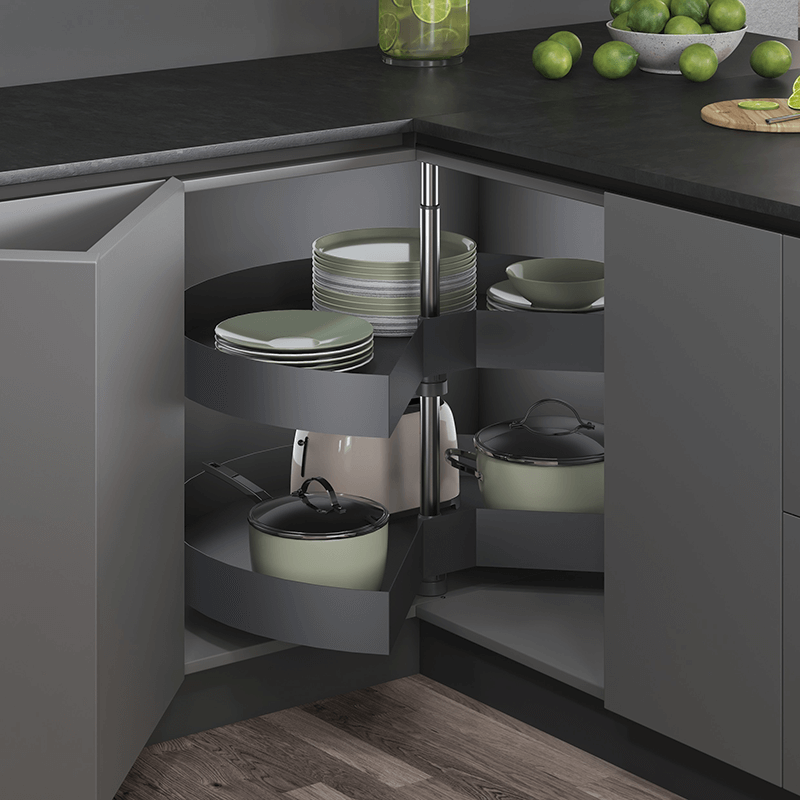
Many homeowners make the mistake of choosing a basket style based on how it looks in a showroom. However, the "Geometry Rule" dictates that the cabinet shell—specifically its footprint and door configuration—decides the hardware. You cannot force a full-circle carousel into a standard blind corner without losing significant functionality. Understanding the geometric profile of Kitchen Revolve Baskets is the first step toward a functional kitchen.
The 180° basket, often called a Half-Moon or D-Shape, serves a very specific architectural constraint. It is designed for "blind corner" cabinets where one leg of the kitchen counter runs into a wall, leaving only a single cabinet door accessible. The other half of the cabinet is buried deep in the corner, hidden behind the adjacent appliance or drawer bank.
Ideally suited for cabinets with widths between 900mm and 1000mm, this system features a pivoting arm. When you open the single hinged door, the basket pivots outward, bringing the contents into the light. High-quality 180° systems require a door opening angle of at least 90 degrees to function smoothly. While this mechanism significantly improves reachability compared to a static shelf, it has a notable constraint. It does not utilize the deepest back corner of the cabinet effectively. It sacrifices that volume to ensure the user does not have to crawl inside the cupboard to retrieve a pot.
If your kitchen layout features a classic L-shape where two runs of cabinets meet at a 90-degree angle, you likely have an "Easy Reach" cabinet with bi-fold doors. This is the domain of the 270° basket, also known as the Pie-Cut or Three-Quarter circle. It is currently the industry standard for optimizing L-shaped corners.
The genius of the 270° design lies in its shape. It looks like a Pac-Man shape or a circle with a pie slice removed. This "cutout" is critical because it aligns perfectly with the 90-degree corner of the closed bi-fold doors. The mechanism rotates centrally on a pole, offering a significant ergonomic advantage. Because it rotates on a zero-radius axis, you can access items immediately without pulling hardware out into the kitchen aisle. This allows for fluid movement in the kitchen, as the user remains stationary while the storage comes to them.
The 360° basket is the heavyweight champion of storage density, but it requires a specific floor plan. It is exclusive to diagonal corner cabinets, which have a pentagonal (five-sided) footprint, or upper wall corner cabinets. These cabinets usually have a single door that sits on a 45-degree angle relative to the rest of the kitchen.
Because the cabinet shape is roughly circular or hexagonal inside, a full-circle basket maximizes the surface area per square inch. There are no cutouts and no straight edges. The continuous rotation mechanism means you can spin the shelves indefinitely to find items. For chefs who need bulk storage for heavy goods, high-quality Kitchen Revolve Baskets in a 360° configuration offer the highest efficiency.
Once you have identified the correct geometry, you must filter options based on engineering quality. A cheap basket system looks identical to a professional one in a photograph, but performance diverges rapidly under load. You need to evaluate load capacity, rotation mechanics, and standardized durability ratings.
Kitchen storage is heavy. A stack of ceramic dinner plates or a Dutch oven can easily weigh 5kg to 8kg. Entry-level hardware often caps out at 10kg to 15kg per shelf. This is insufficient for heavy cookware. Under this weight, plastic hubs warp, and the shelves begin to drag on the bottom of the cabinet.
You should seek commercial-grade options rated for 25kg to 50kg per shelf. A critical evaluation check is "vertical sag." Specifications should ideally indicate a sag of less than 0.5mm under full load. This rigidity ensures the basket remains perfectly aligned with the door opening over time. Regarding materials, prioritize heavy-gauge wire with chrome plating or solid bottom surfaces like maple or melamine. These materials resist deflection far better than standard plastic polymers, which tend to bow over time.
The "feel" of the kitchen relies on how smooth the hardware operates. Professional units manage torque effectively, requiring less than 2N (Newtons) of force to initiate rotation. If a basket requires a heavy shove to move, it increases strain on the central pole mounting points.
Furthermore, noise control is a marker of luxury engineering. You should look for specifications indicating operation below 30dB, often described as "whisper quiet." This is achieved through advanced bearing systems and damping features. A "Soft Stop" or speed-limiting feature is also essential. Without it, spinning a loaded basket too quickly can cause centrifugal force to launch spice jars or cans off the shelf. Damping systems gently brake the rotation as it returns to the home position, keeping contents secure.
Do not rely on marketing promises; rely on standardized testing. Reputable hardware manufacturers test their products against industry benchmarks such as ANSI/BHMA A156.9 (North American standard) or EN 15570 (European standard).
The standard benchmark for residential hardware is 50,000 cycles. This simulates opening and closing the unit multiple times a day for over a decade. High-end European hardware often pushes this boundary, testing up to 200,000 cycles. Accessing this data ensures you are buying a mechanism that will outlast the kitchen cabinetry itself.
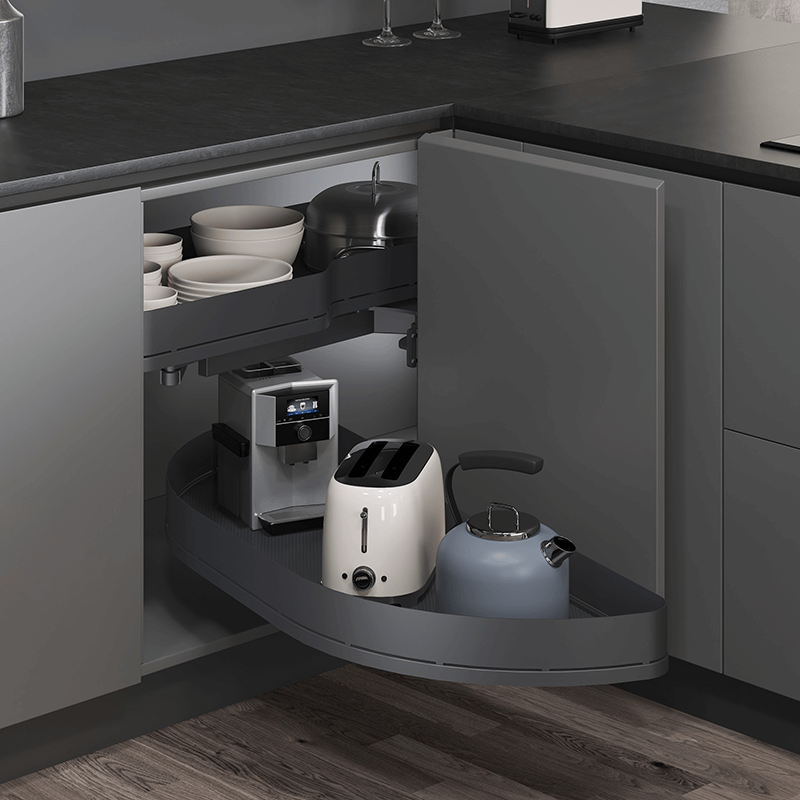
When dealing with blind corners, homeowners often face a choice between a traditional revolving half-moon and a more complex pull-out system. This brings us to the comparison between standard rotational hardware and the Kitchen Magic Corner.
It is vital to clarify the terminology. While both solutions solve the blind corner problem, their motion is entirely different. Revolve baskets utilize rotational motion around a fixed axis. A Kitchen Magic Corner utilizes a linear pull-out system. When you open the door, the front baskets pull out into the room, while the rear baskets slide laterally from the blind spot to the door opening. It is a complex, multi-stage mechanical dance.
If your primary goal is maximizing volume, the Magic Corner often wins. Because rectangular baskets fit better into a rectangular cabinet shell, a Magic Corner utilizes approximately 80% of the available square footage. In contrast, a 180° half-moon revolve basket utilizes closer to 60% because the curved shape leaves the distinct back corners of the cabinet empty.
However, volume is not the only metric. Revolve baskets offer faster access. A single rotational motion reveals the items. A Magic Corner requires a two-stage pull to access the rear goods. Furthermore, revolve baskets generally have lower mechanical failure rates simply because they have fewer moving parts and linkages than the intricate slide systems of a magic corner.
| Feature | Revolve Baskets (180°/270°) | Kitchen Magic Corner |
|---|---|---|
| Motion Type | Rotational (Spin) | Linear (Pull & Slide) |
| Space Usage | ~60% (Rounded shapes lose corners) | ~80% (Rectangular shapes fit corners) |
| Complexity | Low (Single axis) | High (Multi-track system) |
| Typical Load | 25kg - 50kg total | 25kg - 40kg total |
Budget is a major differentiator. Due to the sophisticated sliding tracks and soft-close pistons, Kitchen Magic Baskets typically command a 2x to 3x price premium over standard revolve baskets. Installation complexity also scales with price. A revolve basket usually requires mounting a center pole or simple brackets. A Magic Corner requires precise door mounting alignment and track installation. If the alignment is off by even a few millimeters, the system may jam or fail to soft-close.
The most common reason for returning corner hardware is sizing errors. Cabinets are sold by external dimensions, but hardware fits into internal dimensions. Before purchasing, you must navigate the "Clear Width" trap.
Never buy hardware based on the external width of your cabinet (e.g., a "900mm corner unit"). You must measure the internal clear width and the actual door opening clearance. The door hinges often protrude into the opening, reducing the passable width. A good rule of thumb is to allow 26mm to 38mm of clearance for the pole hardware and rotation radius. If your basket diameter is 800mm, your internal cabinet space needs to be at least 810mm to 820mm to prevent scraping against the side walls.
Vertical space is just as critical. Most base cabinets have a standard height, but the internal clearance can vary due to drawer lines or sink plumbing. Check the telescoping range of the center pole. Standard ranges are usually 600mm to 750mm for base cabinets. If you have full-height pantry cabinets, you will need a specialized taller pole.
You should also verify shelf adjustability. Fixed shelves are a liability. You need the ability to change basket heights to accommodate tall stock pots on the bottom and short canned goods on the top. High-end models allow you to unlock and slide the baskets up and down the pole without uninstalling the entire unit.
Are you installing a new kitchen or fixing an old one? For a new install, baskets are typically dropped into the cabinet before the countertop is installed. This is the easiest method. However, for a retrofit, you cannot easily insert a solid pole into a cabinet that already has a granite countertop on it.
For retrofits, you require a basket system with a split-pole design or removable collars. These telescoping poles can be compressed to fit inside the cabinet and then expanded to lock into the floor and ceiling of the cupboard. This allows you to upgrade your storage without the massive expense of removing your countertops.
Investing in high-quality corner storage offers returns in longevity, ergonomics, and home value. It is tempting to save money on "hidden" hardware, but the total cost of ownership tells a different story.
Cheap polymer revolving trays are prone to cracking at the center hub. This usually happens after 3 to 5 years of daily use. Once the hub cracks, the shelf becomes unstable and eventually unusable, requiring a difficult replacement process. Conversely, stainless steel (304 grade) or heavy chrome wire baskets offer lifespans exceeding 15 years. While the upfront pricing is higher (Tier 1 pricing), the amortized cost over the life of the kitchen is significantly lower because you buy it once.
We can also frame value through the lens of "Back Health." Kitchen tasks involve repetitive bending and reaching. For aging-in-place designs or Universal Design compliance, reducing strain is paramount. A well-engineered Kitchen Magic Corner or revolve basket brings the load to the user at waist height. This eliminates the need to kneel on the floor and reach into a dark cupboard, reducing the risk of back strain.
Finally, consider resale value. Kitchens sell homes. High-functioning corner storage is a highly visible selling point during open houses. A smooth-gliding, commercial-grade corner organizer signals a quality renovation. In contrast, a broken, jamming, or yellowed plastic lazy susan is an immediate detractor that suggests the kitchen needs work.
Choosing the right corner solution is about respecting the architecture of your kitchen. To summarize the verdict: 360° baskets are the champions for diagonal cabinets, 270° baskets are the standard for L-shapes with bi-fold doors, and 180° baskets or Magic Corners are the solution for blind spots.
Your final selection advice is simple: prioritize the mechanism's weight rating over the finish aesthetics. A beautiful bronze basket is useless if it cannot hold a set of cast iron skillets without dragging. Engineering must come first. As a next step, take a tape measure to your kitchen today. Measure the internal opening width, the depth, and the height before browsing catalogs. These three numbers are the key to unlocking the hidden potential of your kitchen corners.
A: Generally no. A 360° full circle basket requires a specific width and depth that matches its diameter. Putting a round peg in a square hole results in significant wasted space at the corners. Furthermore, you need a door opening wide enough to accept the full diameter of the circle, which standard rectangular cabinets rarely possess.
A: You should look for specifications citing 25kg to 30kg per shelf. This means a two-shelf system can hold a total system load exceeding 60kg. This is sufficient for heavy canned goods, appliances, and cookware stacks. Always verify if the rating is "dynamic" (while moving) or "static."
A: The primary difference is motion. A Lazy Susan (Revolve Basket) rotates around a central axis. A Kitchen Magic Corner uses a track system to pull baskets out of the cabinet linearly. Magic Corners maximize space efficiency in blind corners better but cost significantly more and are harder to install.
A: Most heavy-duty options use a telescoping center pole for stability and weight distribution. However, some high-end European models mount directly to the cabinet floor and ceiling or side walls, eliminating the pole obstruction. These pole-free designs offer cleaner aesthetics and more flexible loading space but often come at a higher price point.



