



Views: 0 Author: Site Editor Publish Time: 2026-07-05 Origin: Site


Securing dependable hardware for multi-unit renovations is a high-stakes balancing act. Procurement managers and wholesale buyers constantly juggle rigid project timelines against unyielding supplier constraints. Relying heavily on B2C retail channels quickly erodes your profit margins. At the same time, unpredictable offshore sourcing introduces supply chain opacity, quality fade, and erratic delivery schedules. Navigating these hurdles requires a strategic approach to bulk procurement.
We provide a transparent, data-driven framework to help you secure the right hardware efficiently. You will learn how to evaluate core production capabilities and negotiate Minimum Order Quantities (MOQs) effectively. We also break down how to accurately calculate end-to-end lead times for complex bulk orders. By the end of this guide, you will have actionable strategies to optimize your supply chain and keep your renovation rollouts perfectly on track.
Standard MOQs for off-the-shelf storage systems typically range from 100 to 500 units, while OEM designs require higher thresholds to offset tooling costs.
End-to-end lead times must account for sample approval (7-14 days), mass production (30-45 days), and freight transit (20-40 days).
Partnering directly with a specialized kitchen pull-out basket layout factory reduces communication bottlenecks and ensures precise dimensional compatibility for complex renovation floor plans.
Material verification (e.g., 304 vs. 201 stainless steel) and mechanism stress-testing are critical to preventing post-installation failures in commercial and residential developments.
Procuring hardware for extensive renovations demands a shift in strategy. Many contractors initially turn to retail networks to source materials. However, B2C models consistently fail at scale.
Retail channels cater to single-kitchen upgrades. They cannot support the volume required for a 200-unit residential development. You will inevitably face inconsistent stock levels. One batch might feature a polished chrome finish, while the next arrives in brushed nickel. Dimensional uniformity is also a major issue. Retail suppliers frequently switch manufacturers behind the scenes. This causes slight measurement variations between batches. Furthermore, the high per-unit cost of retail pricing severely limits your profitability. Shifting to factory-direct procurement eliminates these margins. It gives you direct control over the manufacturing source.
A successful procurement strategy hinges on three core pillars. First, you need guaranteed volume availability. Factories allocate dedicated production lines for your order, ensuring you never run short. Second, uniform finish quality is non-negotiable. Every apartment in a multi-unit rollout must look identical. Factory-direct sourcing ensures batch-to-batch consistency. Finally, you must achieve synchronized delivery schedules. Phased renovation rollouts depend on precise logistics. The hardware must arrive exactly when the cabinetry installation finishes.
Mismatched layouts introduce significant hidden costs. If a basket is just a half-inch too wide, installation crews waste hours modifying cabinets on-site. You must standardize hardware dimensions across diverse floor plans. Working directly with the manufacturer allows you to verify CAD drawings before mass production begins. You can standardize your core kitchen pull-out basket specifications across multiple cabinet styles. This reduces installation bottlenecks and prevents expensive on-site labor overruns.
Navigating Minimum Order Quantities (MOQs) is a common hurdle for procurement managers. Factories impose MOQs to optimize their machine setups and raw material purchasing. Understanding these brackets helps you plan your inventory efficiently.
Suppliers categorize items into standard and custom tiers. Standard, white-label items present the lowest barriers to entry. For example, a standard wire storage basket typically requires an MOQ of 100 to 300 sets per SKU. The factory already owns the molds and tooling. They can easily slide your order into their existing production schedule. Conversely, OEM or custom-dimension orders face stricter thresholds. If you need a unique width to fit a proprietary cabinet design, expect an MOQ of 500+ sets. The factory must justify the time and expense required for bespoke tooling, jig setups, and initial machine calibration.
Hardware Sub-Category | Product Type | Typical MOQ Requirement | Tooling Requirements |
|---|---|---|---|
Standard Storage | Wire Baskets (Standard Dimensions) | 100 - 300 Sets | Existing Molds |
Corner Solutions | Magic Corners / Blind Pull-Outs | 50 - 150 Sets | Existing Tooling |
Custom OEM | Proprietary Sizes / Branded Units | 500+ Sets | Bespoke Tooling & Jigs |
Hitting high minimums for every single SKU is often unrealistic for smaller projects. Top-tier suppliers solve this by offering mixed container allowances. They allow buyers to consolidate multiple SKUs within a single 20ft or 40ft HQ container. You can mix basic base cabinet baskets with premium high-tier units. This strategy helps you meet the factory's overall minimum spend threshold without overstocking a single item. Always ask your supplier if they calculate MOQ by total order value or strictly by individual SKU volume.
Smart buyers never commit to 500 units blindly. The procurement cycle always starts with prototype orders. Factories usually allow a sample MOQ of 1 to 5 sets. You will pay a premium price for these initial prototypes. However, reputable factories credit this sample cost toward your final bulk order invoice. This practice mitigates your initial financial risk. It also provides physical proof of quality before you authorize mass production.
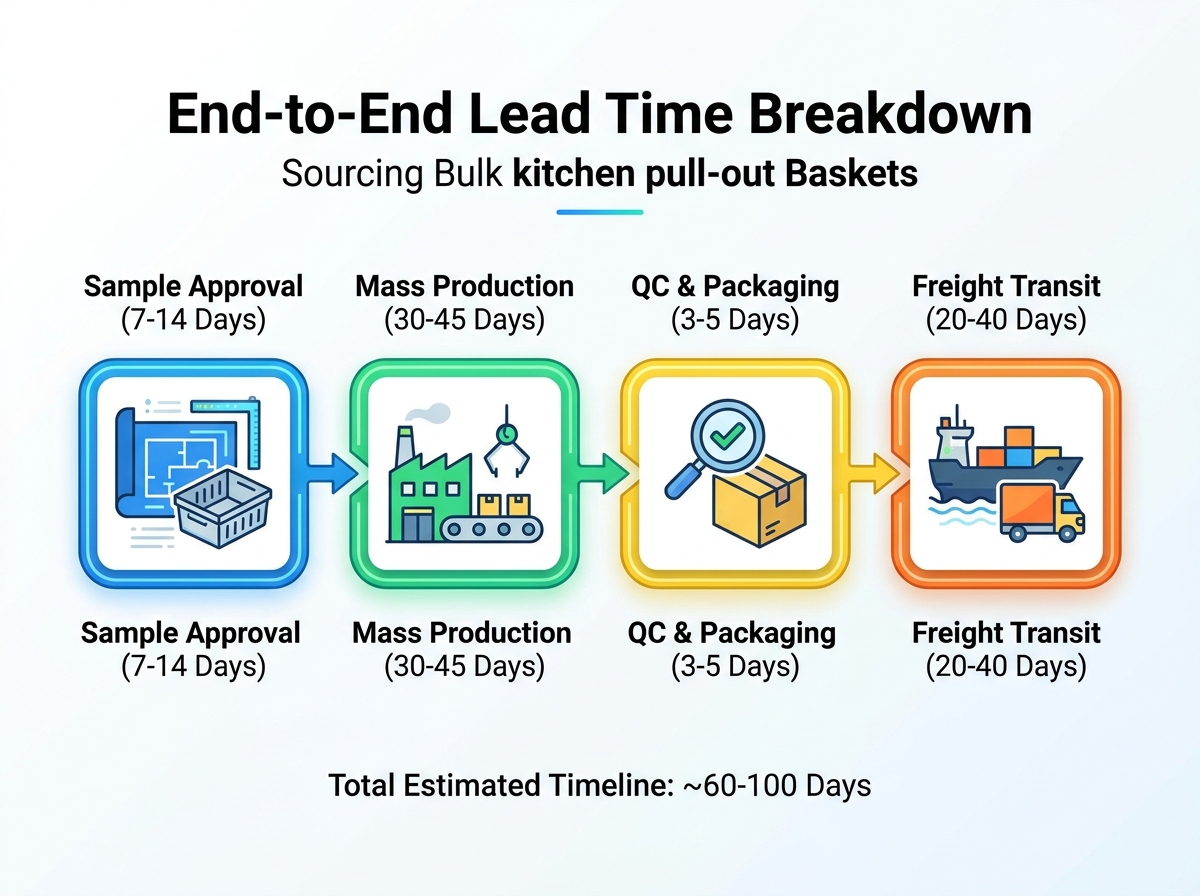
Accurate scheduling is critical for renovation projects. Delays in hardware delivery will stall your entire installation crew. Partnering directly with a dedicated kitchen pull-out basket layout factory removes middlemen and clarifies communication. You need to understand exactly how they calculate their production timelines.
Factory timelines follow a strict sequence. Missing one step pushes the entire delivery date back.
Order Confirmation & Material Sourcing: This takes 7 to 10 days. The factory must secure raw steel, slide mechanisms, and plating materials based on your exact volume.
Manufacturing & Assembly: Expect 25 to 35 days for standard models. For complex, multi-component systems, this stretches to 40 to 50 days. Welding and finishing require precise calibration.
Quality Control (QC) & Packaging: This final stage takes 3 to 5 days. Teams inspect slide smoothness, payload capacity, and finish consistency before boxing the units.
Several variables can disrupt this schedule unexpectedly. Peak season bottlenecks are the most common culprit. The weeks leading up to the Lunar New Year see massive factory congestion. Custom electroplating introduces another frequent bottleneck. Strict environmental regulations often limit plating facility operating hours. Additionally, sudden shortages of specific hardware, such as specialized hydraulic dampeners, can halt an assembly line entirely. You should build a two-week buffer into your project schedule to absorb these potential shocks.
Misinterpreting vendor quotes is a common mistake. When a factory quotes a "30-day" lead time, they almost always mean production days only. This estimate excludes the initial weeks spent iterating samples. Most importantly, it excludes final ocean freight. Ocean transit can add 20 to 40 days depending on your destination port. Always ask your vendor to define their timeline assumptions. Demand a clear calendar mapping from the deposit date to the port arrival date.
Selecting the right hardware goes beyond matching dimensions. You must evaluate the practical demands of the end-user environment. Multi-tenant properties experience heavy wear and tear. Your hardware must survive daily abuse without requiring constant maintenance calls.
Base cabinets handle the heaviest daily loads. Tenants pack them with cast-iron pots, heavy pans, and stacked dishware. You must evaluate the durability of standard systems under these conditions. Look at the wire gauge and welding points. Thin steel will warp and bend under pressure. The slide rails must support dynamic loads of at least 30 to 40 kilograms. If the rails flex during extension, the entire mechanism will eventually derail.
Corner cabinets represent a major design challenge. Installing a basic shelf wastes valuable deep storage space. You must conduct a cost-benefit analysis between different mechanical solutions. A standard blind corner pull-out is cost-effective but limits full access. In contrast, a premium soft-close magic corner utilizes the entire cavity beautifully. However, you must assess installation complexity. Magic corners rely on complex articulation joints. In multi-tenant environments, rough handling can cause these joints to fail. Weigh the aesthetic appeal against the potential maintenance requests before specifying complex corner units for high-turnover rentals.
Tall pantry units require exceptional engineering. A fully loaded pantry pull-out can weigh over 80 kilograms. The weight capacity and glide-rail requirements are extremely strict for these heavy-duty units. The bottom-mount slides must absorb massive downward pressure. The top guide rails must prevent lateral swaying. Ensure the soft-close mechanisms are rated for heavy capacity. A weak dampener will fail to catch a heavy pantry door, leading to violent slamming and damaged cabinet faces.
Never rely solely on a vendor's verbal material claims. You must request independent verification. Ask for SGS testing documents or recent salt-spray test reports. These documents verify true 304 stainless steel claims. Many lower-tier suppliers secretly substitute 201-grade stainless steel to cut costs. While they look identical initially, 201-grade materials suffer from rapid corrosion in humid kitchen environments. Rusting hardware destroys a newly renovated kitchen's appeal. Protect your investment by demanding rigorous material transparency upfront.
A successful multi-unit project requires a long-term manufacturing partner, not just a one-time vendor. You must vet factories on their systemic reliability and compliance standards before transferring any deposits.
Start by verifying basic quality frameworks. Check for current ISO 9001 certifications. This proves the factory maintains standardized quality management systems. Next, dive into specific mechanical tests. Request cycle-testing standards for their slide mechanisms. Industry-standard dampeners and slides should easily survive 50,000+ open and close cycles. This translates to over a decade of typical residential use. If a factory cannot provide these cycle reports, their hardware is likely not suited for commercial developments.
The best hardware is useless if your local contractors cannot install it efficiently. Assess the factory's implementation support. Request detailed installation manuals and physical CAD templates. Your installation crews need clear, visual guides. They must scale the installation process quickly across hundreds of units. If the hardware requires highly specialized training or proprietary tools, labor costs will skyrocket. Standardized, easy-to-read templates keep your contractors moving fast.
To move forward effectively, follow this sequence with your shortlisted suppliers:
Request the factory's standard MOQ and lead time policy sheet to compare baseline capabilities.
Audit their standard tolerances for dimensional accuracy to ensure compatibility with your cabinetry.
Order a mixed sample batch to physically stress-test the payload capacity and verify slide smoothness in your own facility.
Profitable bulk renovation relies heavily on aligning your project schedule with a factory's true production bandwidth. You must understand their MOQ flexibility and how they structure their lead times. Ignoring these factors leads to budget overruns and delayed handovers.
We strongly recommend prioritizing factories that offer transparent lead-time tracking and rigorous material testing. Favor suppliers who provide mixed-SKU container optimization over those competing solely on the lowest unit price. Quality and reliability will always save you money in the long run.
Take action today to secure your supply chain. Submit your cabinet layout plans and estimated volume to your preferred manufacturer. You will receive a project-specific MOQ breakdown and an accurate production timeline, allowing you to plan your next major renovation with absolute confidence.
A: Yes, standard industry practices generally accommodate this. Factories recognize the need for physical evaluation before mass production. You can usually negotiate a paid sample or a small pilot run. However, be prepared to pay a premium unit price for this trial batch. Suppliers typically credit this premium back to you once you place the full mass production order.
A: Customizing your packaging extends the production schedule. Printing branded corrugated boxes, custom instruction manuals, and applying specific logo decals requires coordination with third-party print shops. You should expect an addition of 10 to 14 days to your standard lead time. Finalize your artwork early to minimize this delay.
A: Reputable factories utilize strict packaging protocols to protect sensitive components. They use molded EPE foam and secure the slide tracks to prevent movement. Standard warranty terms usually cover transit damage if you use their recommended freight forwarders. Furthermore, good suppliers often include a small percentage of spare hardware in bulk shipments to cover any minor transit anomalies.
A: Wire baskets require extensive spot welding and multiple electroplating or polishing passes. This can slightly extend the finishing phase. Solid-base baskets rely more heavily on sheet metal bending and precision laser cutting, requiring fewer individual weld points. Depending on the factory's specific machine capacity, solid-base units can sometimes move through the assembly line a few days faster.



